
Many institutions can produce a vendor risk assessment. Fewer can answer a harder question with any confidence: if a specific vendor failed tomorrow, what actually breaks, how far does the damage travel, and how long does recovery take.
That gap, between having a third-party risk program and having real visibility into operational dependency, is where most resilience failures originate. Not at the vendor relationship itself, but several layers beneath it, in the subcontractors, infrastructure providers, and shared utilities the direct vendor relies on and the institution has never been asked to assess.
What the Assessment Measures, and What It Misses
Most third-party risk programs are built around contract value and criticality tiering. A vendor with a large contract or a function labeled critical gets the full due diligence package. A vendor with modest spend gets a lighter touch.
That logic holds up from a procurement standpoint. It does not hold up from an operational resilience standpoint, because contract value and operational dependency are not the same variable. A vendor billing a few thousand dollars a month can sit at the center of a process the institution cannot run without for more than a few hours. When that vendor fails, or when something that vendor depends on fails, the actual cost bears almost no relationship to what was budgeted for that risk.
The Real Cost of Failure: A Case Study
Consider a composite drawn from a pattern I have seen repeatedly across community banks, capital markets firms, and fintechs. A mid-sized institution relies on a third-party provider for a specific operational function, document processing, payment reconciliation, trade confirmation, the function varies but the shape of the failure does not. The vendor is well vetted. The institution holds a signed SOC 2 report, a current business continuity attestation, and a documented escalation path.
The failure does not originate with the vendor. It originates with a subcontractor the vendor relies on for a piece of infrastructure the institution never identified as a distinct dependency. The vendor’s own incident response lags because the vendor itself is waiting on its subcontractor. The institution’s escalation path assumes the vendor controls the resolution timeline. It does not.
The assessment measured the vendor relationship. The failure occurred one level below it.
The direct cost gets tracked immediately: transaction backlogs, missed settlement windows, client notifications. In many institutions, that direct figure is frequently a fraction of the total. What gets underestimated in advance is everything that surfaces afterward. Internal teams lose weeks reconstructing what happened because the vendor’s own incident report is incomplete or late. Regulatory attention intensifies once the failure is disclosed. Manual workarounds put in place during the incident often stay in place for months, because the root cause sits with a subcontractor the institution cannot directly remediate.
Reconstruct that timeline honestly and the total cost, direct loss plus remediation labor plus regulatory response plus the workaround period, typically runs several multiples of the initial estimate. That gap between projected and actual cost is the finding worth taking back to the risk committee, not the incident itself.
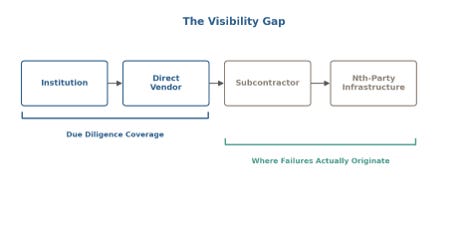
Due diligence concentrates on the direct vendor relationship. The failure originates one to two tiers further down, where the institution has no independent visibility.
Building Visibility That Scales
The constraint here is not institutional will. It is that full due diligence on every subcontractor a vendor relies on is not operationally realistic. Risk functions cannot run a complete assessment on every fourth and fifth party in its ecosystem, and pretending otherwise produces a program that looks thorough on paper and tells you nothing when it matters.
What works instead is deliberate prioritization. Rather than extending due diligence uniformly, identify which nth-party dependencies are concentrated enough, or sit close enough to a critical process, to warrant direct visibility. Build resilience testing scenarios around those specific dependencies rather than around the direct vendor relationship in the abstract. For each critical function, ask not only whether the vendor has a continuity plan, but whether the institution has any independent way of knowing something has gone wrong before the vendor reports it.
That is a narrower exercise than assessing an entire vendor ecosystem, and a considerably more achievable one. It is also, increasingly, what examiners are asking to see. The expectation has moved from evidence of a vendor management program to evidence that the institution understands where its actual operational dependencies sit, regardless of which entity holds the contract.
The Question Worth Bringing to the Committee
Most resilience programs can answer whether a vendor has a business continuity plan. Fewer can answer whether the institution would know, independently and quickly, that something had gone wrong at a layer it never directly assessed.
That second question determines what actually happens when a failure occurs. It belongs on the agenda before the next resilience test, not after the next incident report arrives late and incomplete.
This article reflects the author’s independent professional judgment and does not constitute legal, regulatory, or compliance advice. Readers should consult qualified legal and compliance counsel for their specific circumstances. © 2026 Chimayo Consulting LLC. All rights reserved.
This article accompanies the October 14, 2026 Third Party Risk Association and CeFPro Vendor & Third Party Risk USA case study on “The Real Cost of Third-Party Operational Failure.”
Thanks for reading! Subscribe for free to receive new posts and support my work.