
A customer tries to move a meaningful sum of money on a Tuesday afternoon. The transaction is legitimate. It is also flagged, held, and routed to a manual review queue that will not clear until the next business day. The customer is not a fraudster. The customer is, at that moment, deciding whether to stay.
This scene plays out thousands of times a day across the financial system: how can banks monetize trust as strategy, turning fraud defense from a cost center into a driver of customer growth. The question is well framed, but the framing itself reveals something the industry has not fully confronted. We have spent decades building fraud and financial crime controls as if trust and growth were separate problems, solved by separate functions, measured on separate scorecards.
The False Choice
Ask most financial institution executives to describe the relationship between fraud controls and customer experience, and you will get some version of a tradeoff: more security means more friction, more friction means more abandonment, and the institution’s job is to find the least-bad point on that curve. This is the mental model that has governed fraud strategy for many.
The tradeoff framing assumes that friction and security move together, that you cannot tighten one without loosening the other. But the actual cost driver in most fraud programs is not the presence of controls. It is the absence of calibration. A static, rules-based fraud model applies roughly the same friction to a $50 grocery purchase and a $50,000 wire transfer, to a fifteen-year customer and a six-day-old account, because static models cannot distinguish risk context at the speed at which transactions actually occur. The customer in the scenario above was not punished for being risky. He was punished for the financial institution’s inability to tell the difference between him and someone who was.
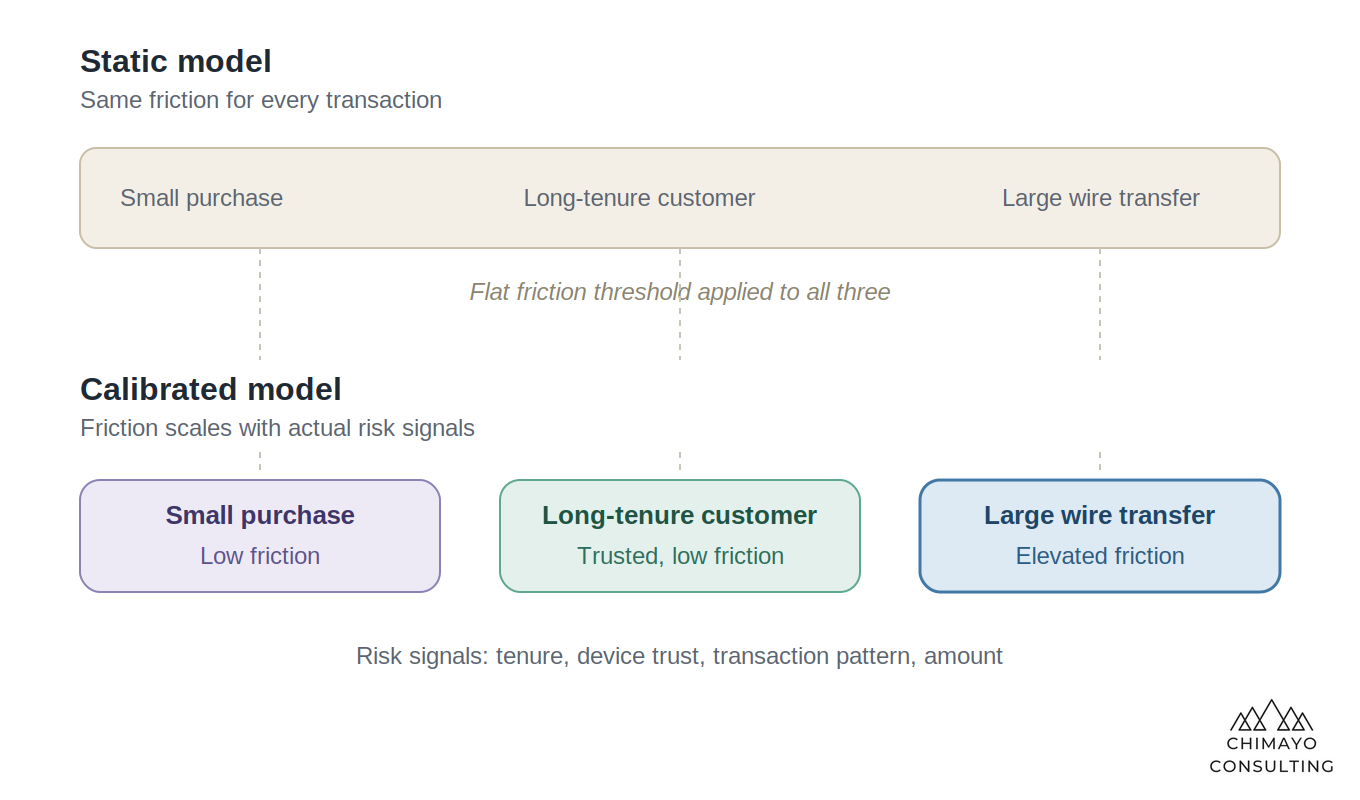
Static friction treats every transaction the same. Calibrated friction scales with actual risk signals.
This is the actual cost of underinvestment in fraud sophistication: not fraud losses, which are bounded and can be budgeted for, but customer attrition, which compounds silently and shows up nowhere on the fraud P&L. Institutions that treat fraud defense purely as a loss-avoidance discipline are optimizing against the wrong denominator.
Trust as a Balance Sheet Asset
Reframe the problem and the economics change. Trust, in a financial services relationship, is not a marketing outcome. It is an operating asset with measurable returns: it lowers customer acquisition cost because trusted institutions earn referral-driven growth rather than paid growth; it increases share of wallet because customers consolidate financial relationships with institutions they believe will protect them; and it reduces churn.
The institutions translating this into strategy are not doing it by relaxing controls. They are doing it by making controls intelligent enough to calibrate, in real time, to the actual risk profile of the transaction, the customer, and the context. Behavioral biometrics, device intelligence, and transaction-pattern modeling allow institutions to apply heavy friction to genuinely anomalous activity while applying near-zero friction to the overwhelming majority of legitimate transactions that previously got caught in the same net. The fraud team is no longer the department that says no. It is the department that makes yes possible, faster, for the customers who deserve it.
This is the actual mechanism by which fraud defense becomes a growth lever. Not because banks market their security posture, although that has its place, but because the customer experience of being correctly trusted, repeatedly, at scale, is itself the product differentiator. In a market where checking accounts are close to being commoditized, the experience of frictionless legitimacy is not.
The Governance Precondition Nobody Wants to Talk About
None of the above works, and in fact becomes a different and more dangerous category of risk, without disciplined governance underneath it.
A behavioral or AI-driven fraud model that has not been properly validated, that lacks documented performance monitoring, that cannot explain its own decisioning to a regulator, is not a growth engine. It is an unmanaged model risk exposure wearing a customer experience costume. The regulatory expectations around model risk management, the kind of rigor institutions already apply to credit and capital models, do not become optional because the use case is fraud detection rather than loan underwriting. If anything, the stakes are higher, because fraud models make thousands of automated decisions per second with direct, immediate customer impact, and regulators are paying close attention to how institutions govern AI-driven decisioning across every function, not just the ones with obvious safety and soundness implications.
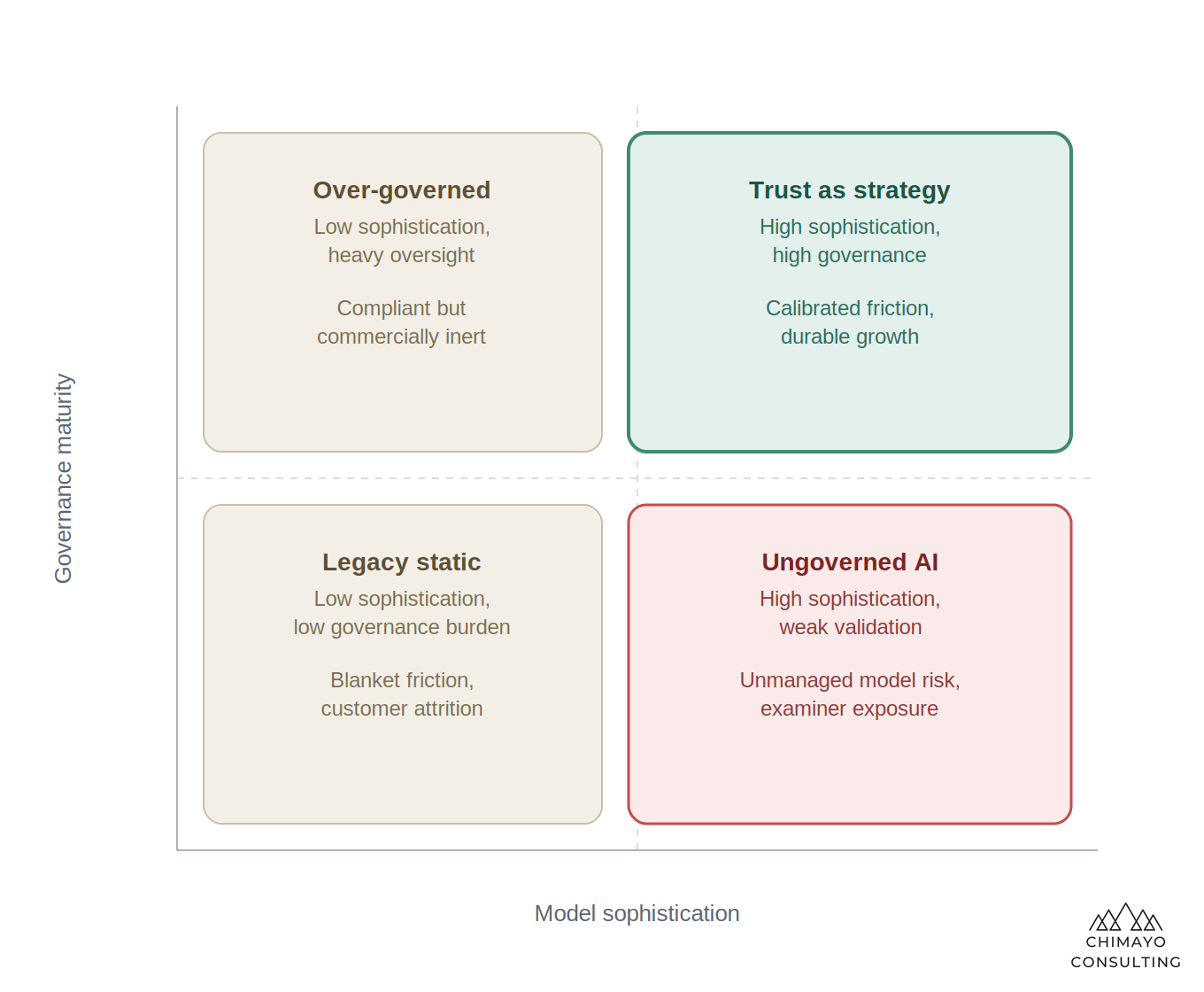
Sophistication without governance is unmanaged risk. Governance without sophistication is commercially inert. Durable growth sits in the intersection.
This is the connective tissue between operational risk discipline and growth strategy that too often gets treated as a compliance afterthought rather than the foundation it actually is. Explainability is not a regulatory checkbox. It is the mechanism that lets a financial institution trust its own fraud model enough to relax friction where it is safe to do so. Validation discipline is not friction on innovation. It is what allows a chief risk officer to sign off on a more permissive model without that sign-off becoming a liability eighteen months later. The institutions that will actually capture the growth upside of intelligent fraud defense are the ones that built the governance scaffolding first, not the ones racing to deploy the flashiest model and hoping the controls catch up.
The Real Question
So the panel question is about whether an institution’s risk and compliance functions are positioned as a strategic capability or a permission desk. Financial institutions that have made this shift are not asking their fraud and financial crime teams to take on more risk. They are asking those teams to get precise enough about risk that the institution stops paying a tax on customers who never should have been treated as suspects in the first place.
That precision, and the governance discipline that makes it durable, is the actual answer to how trust gets monetized into an operating model.
This article reflects the author’s independent professional judgment and does not constitute legal, regulatory, or compliance advice. Readers should consult qualified legal and compliance counsel for their specific circumstances. © 2026 Chimayo Consulting LLC. All rights reserved.