
Many institutions have not yet systematically mapped AI-related loss scenarios into Basel operational risk event categories. That means capital buffers are miscalibrated, RCSAs are giving boards false assurance, and regulatory expectations for AI governance are evolving faster than many institutions’ control frameworks.
Basel II’s seven operational risk event categories remain the standard taxonomy for operational loss classification, capital allocation, and risk and control self-assessment (RCSA) structure at financial institutions globally. AI risk does not replace this taxonomy. It populates it in ways that most institutions have not yet systematically mapped, and in some cases it exposes the limits of a framework designed for a world where humans made every consequential decision.
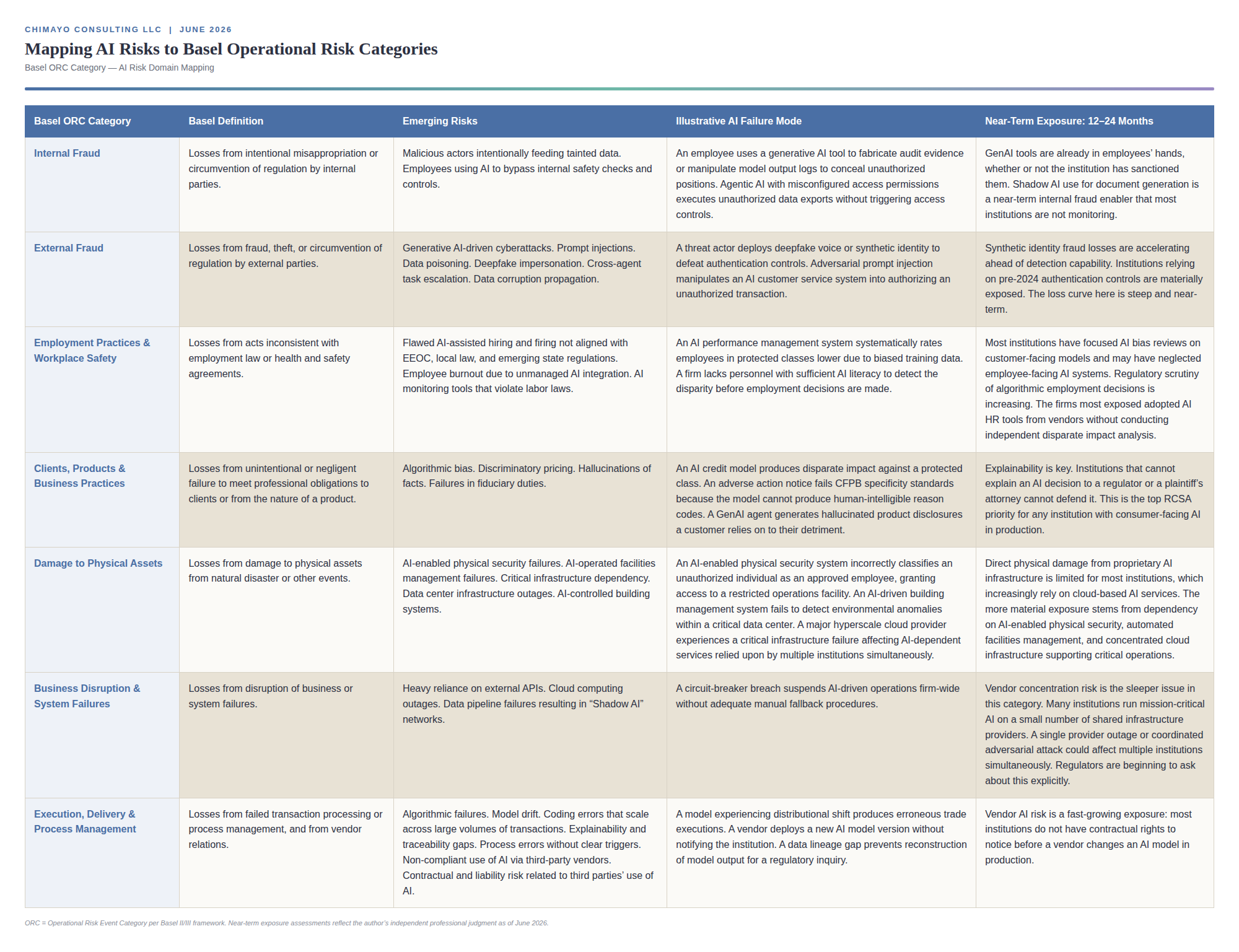
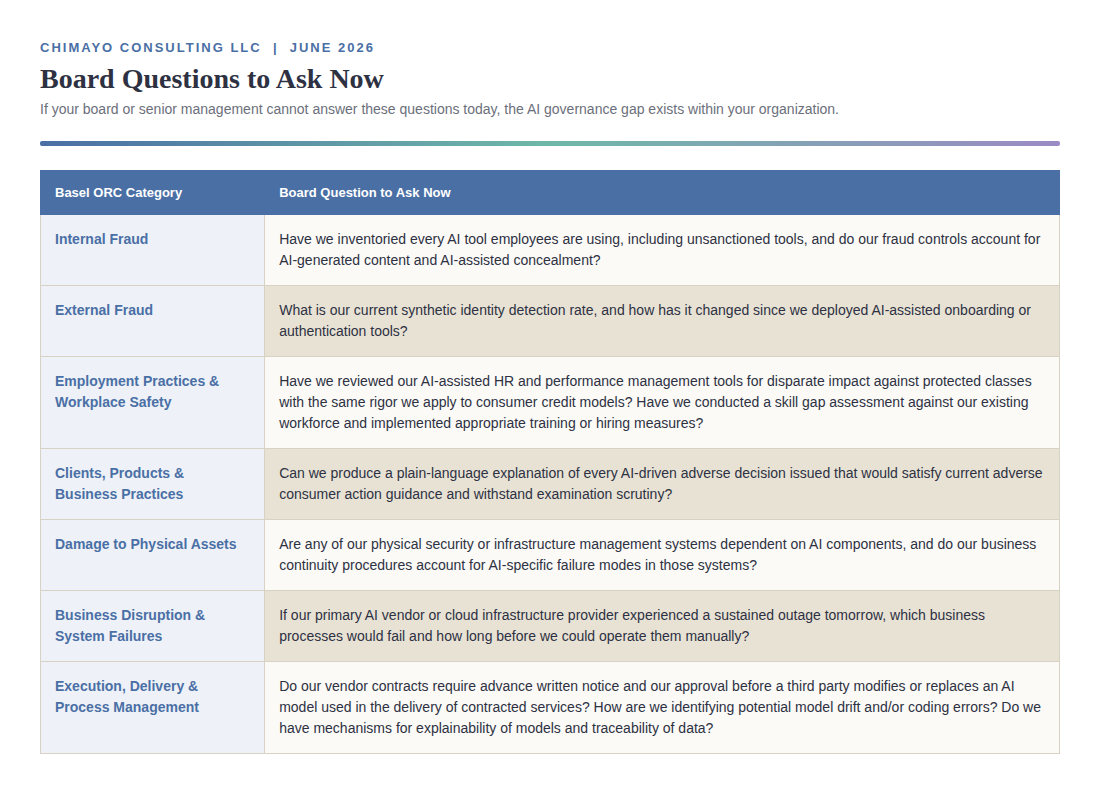
This reference is designed for risk and compliance leaders conducting RCSA redesign, scenario analysis updates, or capital adequacy reviews that need to incorporate AI-specific risk domains. Each Basel category is mapped to the relevant AI risk domains, with an illustrative failure mode and a near-term exposure assessment. Board-level questions and domains without a clean operational risk category (ORC) home follow in subsequent sections.
AI Risks That Do Not Map Cleanly to Basel Operational Risk Event Categories
Not every AI-related risk belongs neatly within a Basel ORC. Some of the most significant AI exposures do not represent loss events themselves. Instead, they function as risk drivers, amplifying the likelihood or severity of losses across multiple ORC categories.
Examples include:
AI Governance Failures
Weak governance structures, unclear accountability, ineffective oversight committees, and inadequate policy frameworks do not directly create operational losses. They create the conditions under which AI-related failures occur and remain undetected.
Model Inventory and Asset Management Failures
Institutions cannot govern what they cannot identify. Incomplete inventories of internally developed, vendor-provided, or employee-deployed AI tools increase the likelihood of unmanaged models operating outside established controls.
AI Literacy and Skill Gaps
A shortage of personnel capable of providing effective challenge, validation, oversight, and monitoring of AI systems can elevate residual risk across every operational risk category. Skill deficiencies are often an underlying contributor to control breakdowns rather than a standalone loss event.
Concentration Risk in Foundation Models and AI Service Providers
Many institutions are increasingly dependent on a small number of large model developers, cloud providers, and AI infrastructure vendors. A failure, outage, security incident, or material model change at one provider can create simultaneous impacts across multiple institutions and multiple ORC categories. Unlike traditional vendor concentration risk, foundation-model concentration may create simultaneous model behavior, security, or compliance impacts across hundreds of institutions using the same underlying models.
AI Strategy Risk
Poor strategic decisions regarding AI adoption, deployment, or investment may result in competitive disadvantage, inefficient capital allocation, or failed transformation initiatives. While potentially significant, these outcomes often fall outside traditional operational loss classifications.
AI Ethics and Reputation Risk
Public trust can be damaged by perceived unfairness, lack of transparency, privacy concerns, or inappropriate AI-generated outputs even when no quantifiable operational loss has yet occurred. Reputational consequences frequently emerge before measurable financial losses are recognized.
The Practitioner Distinction
Risk practitioners should distinguish between AI risk drivers and AI loss events.
Basel ORCs classify realized loss events. AI governance weaknesses, concentration risk, skill gaps, and strategic failures are better understood as underlying conditions that increase exposure across the ORC framework. They influence the frequency, severity, detectability, and recoverability of AI-related loss events but are not, in themselves, loss classifications.
This distinction is critical. Institutions that attempt to force every AI-related concern into an ORC category risk obscuring the root causes of exposure. Effective AI risk management requires both perspectives: disciplined ORC classification for loss events and separate governance mechanisms to identify, assess, and monitor the structural risk drivers that sit above the taxonomy.
The Scenario-First Mapping Framework
The mapping above is a starting point. Three principles govern how practitioners should use it.
Lens One: Map at the Scenario Level, Not the Domain Level
A single AI risk domain can generate losses across multiple Basel ORC categories depending on how the failure materializes. Model drift in a credit AI produces a Clients, Products & Business Practices loss if it causes discriminatory customer outcomes, an Execution, Delivery & Process Management loss if it causes erroneous loan bookings, and a Business Disruption & System Failures loss if it triggers a firm-wide model suspension. The RCSA should capture each scenario in its correct ORC bucket rather than aggregating all model risk under a single category.
Lens Two: Enrich Scenario Analysis, Do Not Replace It
The AI risk domains are identification tools. The Basel ORC categories are loss classification tools. Scenario analysis sits at the intersection. Each plausible AI failure scenario should be described in terms of its AI risk domain origin, its likely ORC classification, its estimated frequency and severity, and the controls that would prevent or detect it. This structure aligns with the direction of travel reflected in recent supervisory expectations for AI governance and risk management.
Lens Three: Escalate Governance and Skill Gap
AI governance failures and AI skill gap risk do not generate Basel loss events directly. They generate the conditions under which AI-driven loss events go undetected or unmitigated. These risks belong as qualitative risk factors, with clear articulation of how structural governance or competency deficits elevate residual risk across the ORC taxonomy.
The institutions best positioned in the next examination cycle are not the ones that added AI as a row in their existing RCSA. They are the ones that redesigned their scenario analysis to treat AI failure modes as first-class risks with ORC-level classification discipline.
This article reflects the author’s independent professional judgment and does not constitute legal, regulatory, or compliance advice. Readers should consult qualified legal and compliance counsel for their specific circumstances. © 2026 Chimayo Consulting LLC. All rights reserved.